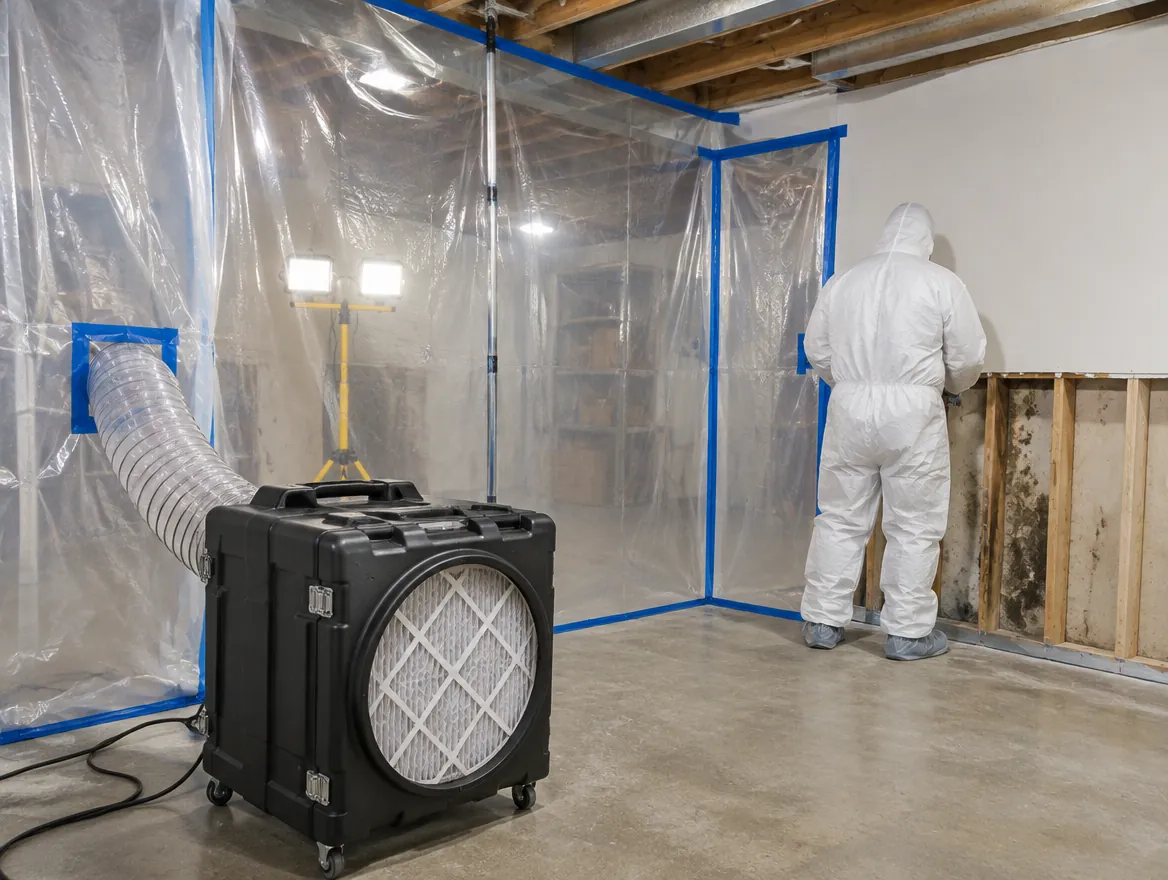
Mold remediation isn't just cleaning a stain. Mold grows where there's moisture, so the job has two halves: get rid of the mold that's there, and fix the water or humidity problem that let it grow. Skip the second half and it comes back, usually in the same spot by next spring.
Call (616) 226-9528Signs it's time to call
- A musty, earthy smell that hangs around a basement, closet or room.
- Black, green or grey spots on drywall, wood, carpet backing or window frames.
- Water you couldn't dry fast: a sump pump failure, a burst pipe, a roof leak or a flooded basement.
- Peeling paint or bubbling drywall on an outside or basement wall.
- Mold that came back after you scrubbed or bleached it.
How a proper job usually goes
- Inspection. The contractor looks at what you can see, then checks for hidden moisture with a meter and sometimes a thermal camera.
- Containment. The work area is sealed off with plastic sheeting and kept under negative air pressure, so spores don't spread to the rest of the house.
- Removal. Moldy porous materials like drywall, carpet pad and insulation are cut out and bagged. Solid surfaces like studs and joists are cleaned.
- Air cleaning. HEPA vacuums and air scrubbers pick up spores and dust.
- Drying and prevention. The area is dried and the moisture source is dealt with, or you're told exactly what needs fixing.
That approach follows the EPA's guidance on mold cleanup (EPA).
Can you handle it yourself?
Sometimes. The EPA says a patch smaller than about 10 square feet (roughly 3 feet by 3 feet) can usually be cleaned by the homeowner, as long as the moisture is fixed. Bigger areas, mold inside walls, mold after sewage or flood water, or anyone in the house with asthma or a weak immune system are good reasons to call a pro.
Water still coming in? Stop the source first if you safely can (shut the water off, run the sump pump, move things off a wet floor), then call (616) 226-9528.
Common questions
How much does mold remediation cost?
It depends on how big the area is, what material is affected and how easy it is to reach. A small basement corner is a very different job from a whole attic. The contractor gives you a price after the inspection, before any work starts.
Will bleach kill the mold?
Bleach can lighten mold on hard, non-porous surfaces, but it doesn't fix the moisture and doesn't reach into drywall, wood or carpet backing. That's why bleached mold so often comes back.
Do I need to leave the house during the work?
Usually not. The work area is sealed off and kept under negative pressure. For large jobs, or if someone in the house is sensitive to mold, the contractor may suggest staying elsewhere.
How long does it take?
Many jobs are done in one to three days. Larger jobs, or jobs where the area needs to dry first, take longer.